ARR-first storage lifecycle management
Your media grows. Your storage should too.
Hoardarr turns real homelab disks, pools, shares, and block storage into one guided lifecycle—from first discovery to expansion, recovery, and eventual retirement.
Alpha validation is underway. Public image coming soon.
A calmer storage workflow
Tell Hoardarr the outcome. It handles the layers.
Standard mode detects the environment, recommends a complete stack, and asks targeted questions about choices that shape your data.
Detect
Disks, paths, sectors, health, pools, filesystems, shares, LUNs, and existing data.
Understand
Media, downloads, backups, VMs, databases, mixed workloads, or a custom goal.
Recommend
Topology, protection, growth plan, datasets or zvols, tuning, and presentation.
Review
A clear summary of capacity, compatibility, and every proposed action.
Apply
One guided plan powered by the same backend policies in both modes.
One engine · two ways to work
Simple enough to start. Deep enough to stay.
Grandma and an ONTAP developer should be able to configure the same complete storage plan at the level that makes sense to them.
Standard mode
Goal-first guided setup
Hoardarr detects hardware, preselects recommended quick options, and explains the decisions that matter.
- ARR and media-library presets
- Recommended layouts from detected disks
- Quick format and fast validation by default
- Clear confirmation for storage-layout choices
Advanced mode
The full storage stack, fully visible
Inspect and tune the same plan layer by layer through one shared storage engine.
- Disk and path characteristics
- Vdev, pool, dataset, zvol, share, and LUN controls
- Multipath, replication, quorum, and HA visibility
- Enterprise-grade controls included
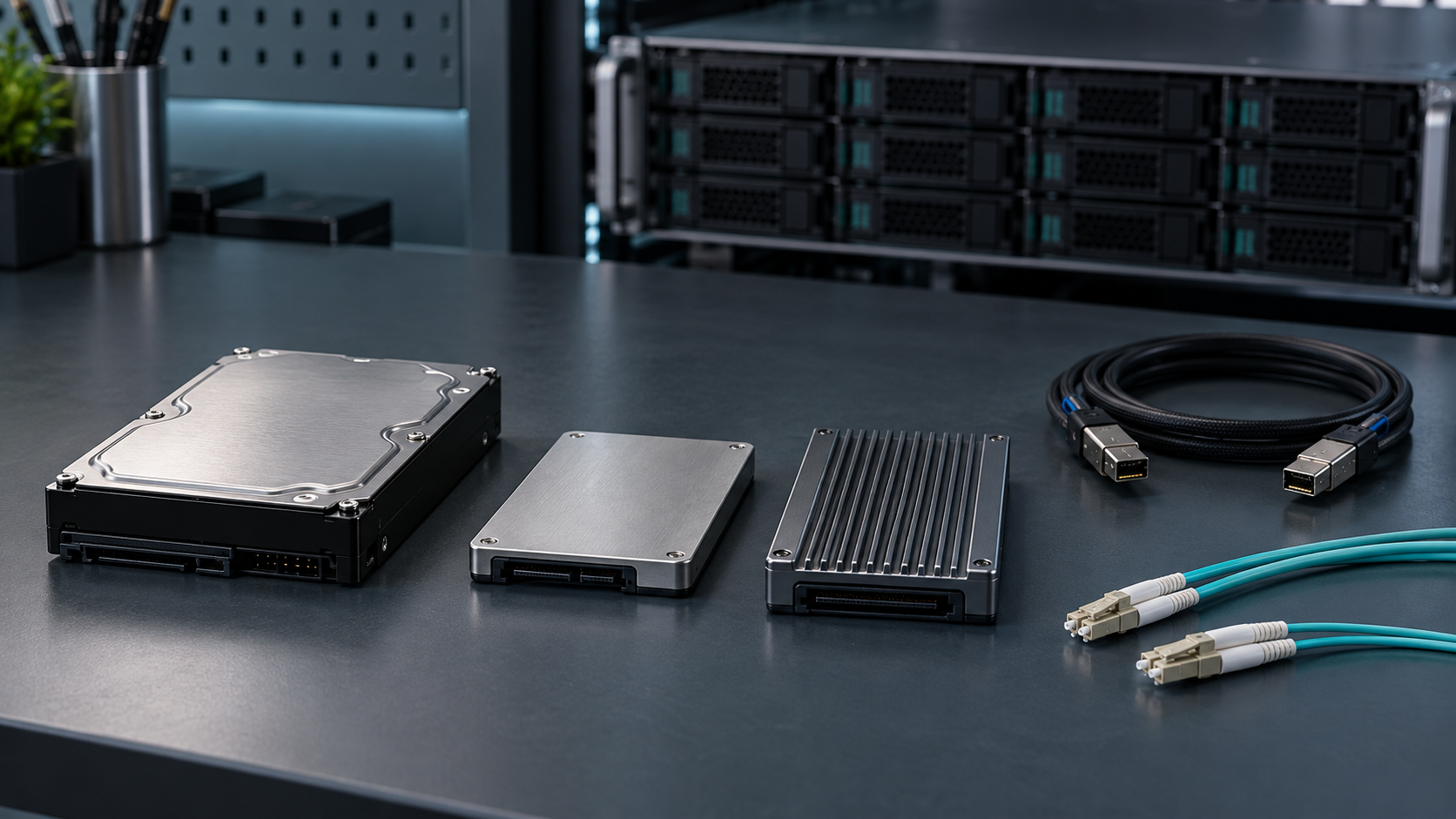
Real hardware, mixed generations, changing connections—exactly the environment Hoardarr is designed to make understandable.
Built for the hardware you have
Local disks, SAS shelves, NVMe, and imported arrays.
Hoardarr connects identity, topology, permissions, and presentation into one understandable storage stack.
Detect before asking
Use real hardware and existing configuration facts wherever they are reliable.
Turn unknowns into questions
Unresolved values become clear, targeted wizard questions.
Preserve the route back
Reviewable plans, readback, stable application paths, and explicit import permission policy.
See the problem before the pool feels it
Storage telemetry that tells a story.
Live graphs already expose throughput, operations, latency, and health. Persistent, per-user Grafana-style dashboards are on the active roadmap.
Media pool · Live performance Live
742 MB/s
Read / write · rolling live window
1,284 IOPS
Peak 1,741 IOPS
Online
Five data devicesHealthy
Last scrubClean
Multipath links2 / 2
Write latency2.4 ms
Coming soon
The first Hoardarr Alpha ISO.
A bootable Ubuntu 24.04-based image is on the way. The first Alpha delivers a complete, usable standalone storage-server experience.